
Trout and Steelhead Fishing Rigs: Master Terminal Tackle Blueprint
Terminal rigging schematics, tippet micrometer calibrations, and knot engineering for pressured river salmonids.
Tippet Gauge & Terminal Knot Engine
Calculate the exact tippet gauge, micrometer diameter, and optimal knot blueprints based on hook wire gauge and river clarity.
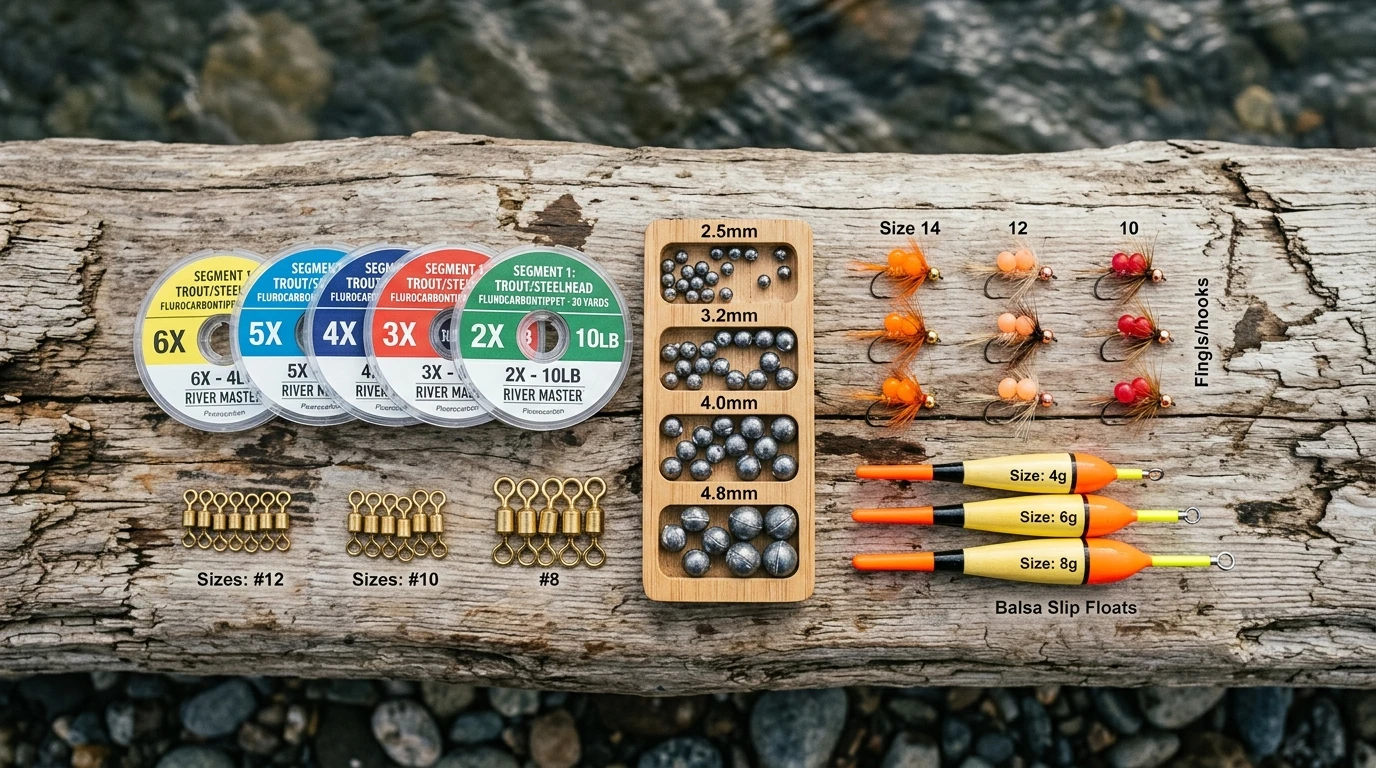
The most effective trout fishing rig is the slip-bobber or fixed-float rig, consisting of a mainline, barrel swivel, 18–24 inches of 4 lb fluorocarbon leader, split shot placed above the swivel, and a size 10–14 single egg hook suspended just off river bottom.
Fundamental Salmonid Rigs Compared
The terminal tackle setup is the direct physical interface between the angler and the fish. Selecting the wrong rig leads to chronic line fouling, lost hardware on river boulders, or rejected presentations from wary, selective trout.
| Rig Architecture | Optimal River Depth | Terminal Connection | Hookset Speed |
|---|---|---|---|
| Slip Bobber Trotting Rig | 5 to 14 feet (Deep Holes) | Barrel Swivel to 4X Fluoro | Instant Visual Indicator |
| Pencil Lead Slinky Drift | 4 to 8 feet (Fast Riffles) | 3-Way Swivel / Snap Swivel | Tactile Rod Blank Tap |
| Euro Mono-Rig (Tight-Line) | 2 to 5 feet (Pocket Water) | Tippet Ring to 5X / 6X Fluoro | Micro-Second Sighter Flex |
| Stillwater Double Bait Rig | 8 to 25 feet (Lake Bottoms) | T-Turn Swivel / Dropper Loop | Slack-Line Take Indicator |
Slip Bobber and Fixed Float Rig Setup
The slip-bobber rig remains the definitive system for fishing moving water deeper than the rod’s length. A neoprene bobber stop is slid onto the braided or monofilament mainline, followed by a glass bead and an aerodynamic balsa or foam slip float. Below the float, a size #10 brass barrel swivel acts as a positive depth stopper.
Tie 18 to 24 inches of 100% fluorocarbon leader to the bottom eye of the swivel. Place your primary split shot array directly onto the mainline above the swivel. This ensures the leader drifts freely without kinks, allowing live bait or acrylic beads to swirl organically along current seams.
Bottom Bouncing and Drift Slinky Rigs
When fishing river chutes loaded with sharp jagged rocks, conventional lead sinkers lodge into crevices and snap lines on every other cast. A slinky weight—constructed from hollow parachute cord packed with lead buckshot and melted closed at both ends—flexes smoothly over boulders.
Critical Knot Blueprints for Zero Line Failure
Fluorocarbon is a hard, dense fluoropolymer with low surface friction and high memory. Traditional knots like the standard Clinch Knot often slip under load unless tied with extreme care.
Palomar Knot vs. Trilene Knot
The Palomar Knot is the benchmark for terminal connections. By doubling the line through the hook eye, the knot provides a dual-strand friction lock that preserves 95% to 98% of line strength. The Trilene Knot is an excellent alternative for small hook eyes where doubled fluorocarbon will not pass, delivering 90%+ wet retention.
Double Uni vs. Blood Knot
When joining lines of similar diameter (such as 3X tippet to 4X tippet), the Blood Knot produces a compact, symmetrical barrel that glides through rod guides without catching. When joining braided mainline directly to fluorocarbon where diameters differ significantly, the Double Uni Knot forms an indestructible wedge.
Tippet Diameter and Refraction Index Physics
Understanding why fluorocarbon outperforms nylon in clear water requires inspecting the physics of light refraction.
Fluorocarbon vs. Monofilament Leader Refraction Indices
Pure water possesses a refractive index of approximately 1.333. Standard nylon monofilament has an index of 1.53, causing light passing through water to bend sharply when striking the line, creating a visible bright silhouette.
Polyvinylidene fluoride (PVDF fluorocarbon) has a refractive index of 1.42—exceptionally close to water. Sunlight passes through fluorocarbon with negligible optical distortion, making 4X and 5X leaders practically invisible to cautious wild brown trout and pressured winter steelhead.
Matching Tippet Diameter (X-Scale) to Hook Size
The universal fly fishing X-scale is governed by the mathematical formula:
Diameter (inches) = 0.011 - (0.001 × X)
To maintain natural bait movement without line twisting, divide the hook size by 3 to 4. For instance, a size #12 hook pairs seamlessly with 4X tippet (0.007 in / 0.178 mm), while a size #18 midge demands 6X tippet (0.005 in / 0.127 mm).
Return to the trout and steelhead tackle master hub to configure complete seasonal rod, reel, and float trotting outfits.
Terminal Tackle Frequently Asked Questions
01 What is the best all-around rig for trout in moving rivers?
The fixed-float or slip-bobber rig using a balsa float, size #10 brass barrel swivel, 18 to 24 inches of 4 lb fluorocarbon leader, and a size #12 egg hook is the most versatile river setup. It presents bait at eye-level while keeping split shot elevated above snaggy bottom structure.
02 Why should split shot be placed above the swivel rather than directly on the leader?
Pinching split shot onto fine fluorocarbon leaders (such as 4X or 5X tippet) creates microscopic stress fractures and weakens line tensile strength by up to 35%. Placing lead shot on the heavier mainline above the barrel swivel preserves 100% of leader strength while allowing the unweighted tippet to drift with maximum natural suppleness.
03 What knot is strongest for tying fluorocarbon to terminal hooks?
The Palomar Knot consistently retains over 95% of line breaking strength on fluorocarbon. Its doubled-line loop cushions the knot against the hook eye, preventing friction burn and knot slippage under sudden violent headshakes.