
Trout and steelhead fishing requires matching rod action, line breaking strain, and presentation to river dynamics. Trout thrive in cold, oxygen-rich pools taking small nymphs and spinners, while anadromous steelhead demand long 10–13ft float or spey rods, light fluorocarbon tippets, and drag-free drift presentations to trigger strikes.
How to Choose Your Core Salmonid Setup
Achieving consistent success on wild rivers requires looking beyond generic rod labels. An angler must evaluate the relationship between blank modulus, guide friction, line inertia, and salmonid jaw morphology.
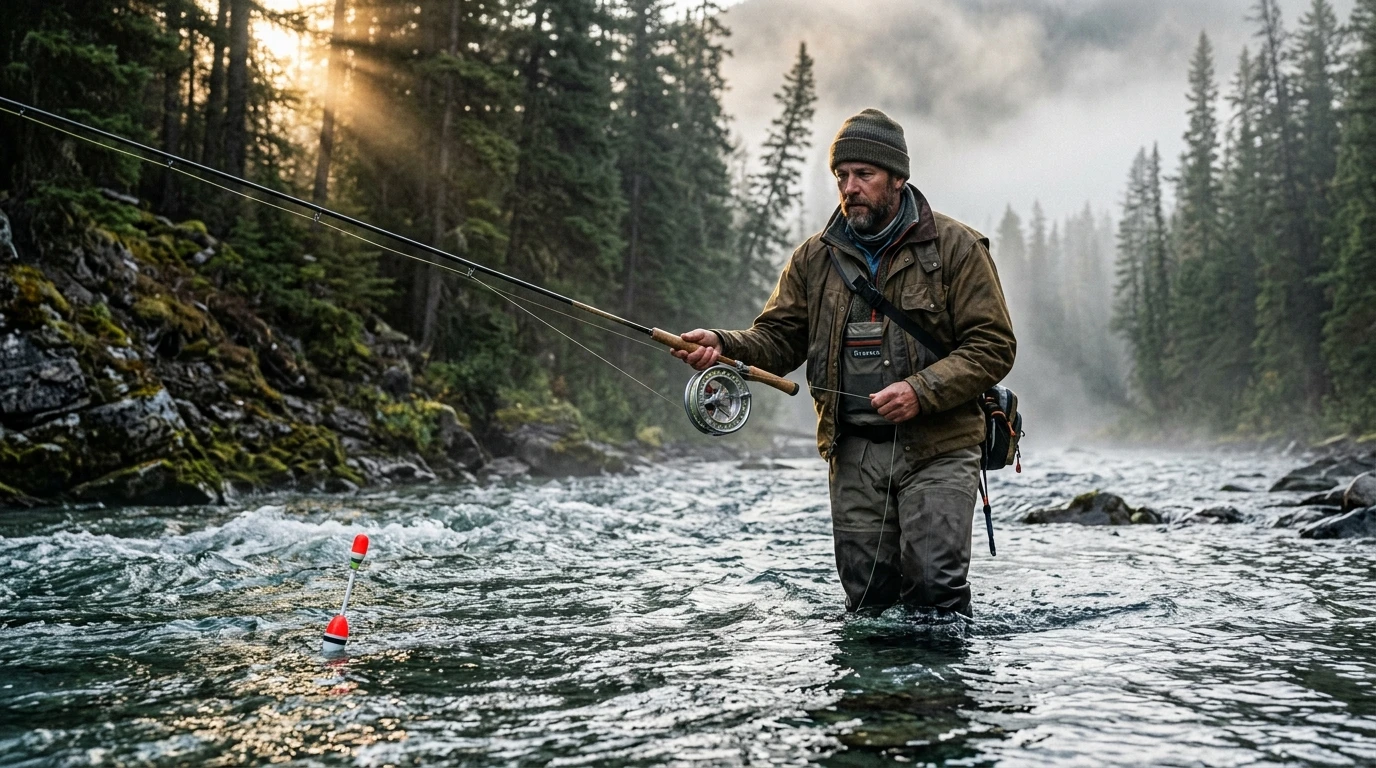
Distinguishing Trout vs. Steelhead Gear Requirements
While river trout and migratory steelhead belong to the same biological genus (Oncorhynchus), their physiological demands on tackle diverge sharply. Resident stream trout measure between 8 and 18 inches, averaging 0.5 to 2.5 pounds. They populate micro-eddies, undercut banks, and gravel riffles where a delicate landing matters far more than raw pulling power.
In contrast, anadromous steelhead spend between one and three years feeding voraciously in open water before returning to their natal rivers. These trophy fish range from 6 to over 15 pounds, armed with thick muscular caudal peduncles built to navigate heavy rapids. Targeting steelhead with light stream rods results in extended fight times that build toxic levels of lactic acid, drastically increasing post-release mortality. A dedicated 10'6" to 13'0" medium float rod with a progressive taper absorbs violent headshakes while keeping 6 to 10 lb fluorocarbon leaders intact.
Spinning vs. Centerpin vs. Fly Fishing Modalities
Selecting an angling modality depends on river width, overhead foliage, and flow rates:
The 4 Fundamental River Rigging Systems
Every successful presentation begins at the terminal swivel. Matching the rigging architecture to the specific river substrate prevents persistent snagging while keeping bait inside the strike zone.
| Rigging System | Water Environment | Key Hardware | Primary Target |
|---|---|---|---|
| Slip-Bobber Float Rig | Deep holding pools (6–14 ft) | Mainline stop, balsa float, barrel swivel, 4 lb fluoro | Suspended Brown Trout & Steelhead |
| Fixed Balsa Trotting Rig | Uniform stream runs (3–6 ft) | Avon float, silicone sleeves, shirt-button shotting | Freestone Rainbows & Brookies |
| Slinky Bottom Bounce Rig | Heavy boulder chutes & rapids | Parachute cord lead slinky, 3-way swivel, yarn fly | Winter Steelhead hugging substrate |
| High-Low Stillwater Rig | Lakes & calm reservoir eddies | Pyramid sinker, dual dropper loops, floating bait | Stocked & Wild Lake Trout |
Float Fishing Trotting Systems
The float rig suspends the bait slightly above river bottom, allowing the current to carry the presentation down the feeding seam. In moving currents, an angler trotting with a centerpin reel holds slight finger pressure on the spool rim, slowing the float just enough so the bait leads the float downstream. This guarantees that when a fish strikes, the hook point penetrates instantly without slack line delay.
Bottom Bouncing and Drift Fishing Rigs
When salmonids hold deep in cold winter currents, they refuse to elevate more than a few inches for a meal. Bottom bouncing utilizes pencil lead or hollow paracord slinkies that tick along gravel bars without wedging between rocks. The leader extends 24 to 36 inches behind the weight, floating small egg clusters, yarn flies, or corkies right at eye level.
Seasonal Salmonid Behavior and Temperature Windows
Salmonids are ectothermic organisms whose enzyme kinetics, oxygen consumption, and strike triggers are governed by ambient water temperature. Consulting USGS river telemetry before stepping into the river dictates tactical selection.
Optimal Water Temperature Feeding Ranges (42°F–62°F)
Between 44°F and 58°F, trout and steelhead display maximum predatory drive. Active feeding lanes form at the heads of pools where oxygenated riffles sweep helpless insects and baitfish downstream. As water warms above 65°F, biological stress escalates rapidly; ethical anglers focus effort during early morning hours and carry thermometer readings to avoid playing fish in warm, hypoxic flows.
River Run Timing Calendar
Migratory steelhead runs follow distinct seasonal pulses:
Explore Deep Field Guides & Tactical Engines
Rod & Reel Combos
Inspect balanced rod lengths, line ratings, and reel spool pairings with our dynamic pairing matrix.
Explore Combos → PILLAR 3Centerpin Float Reels
Master drag-free river trotting mechanics and calculate exact split shot balances with the shotting engine.
Explore Centerpins → PILLAR 4Terminal Tackle Rigs
Calculate micrometer tippet diameters, leader tapers, and inspect step-by-step knot blueprints.
Explore Rigs →Salmonid Field Authority & Frequently Asked Questions
01 What is the primary difference between trout and steelhead gear?
While rainbow trout and steelhead share the same genetic species (Oncorhynchus mykiss), resident stream trout average 10 to 18 inches and are targeted with 6'0" to 7'0" ultralight spinning or 3–5 weight fly rods with 2–4 lb tippet. Anadromous steelhead spend years feeding in oceans or the Great Lakes, returning at 6 to 15 lbs; they require 10'6" to 13'0" float rods, centerpin or 2500–3500 reels, and 6–10 lb fluorocarbon leaders to survive violent river runs.
02 Why is a centerpin reel preferred for river float fishing?
A centerpin reel operates on a 1:1 direct drive with zero mechanical drag, rotating on ultra-low-friction ABEC ball bearings. This allows the river current to pull line off the spool at the exact velocity of the water, creating a true drag-free drift that prevents pressured salmonids from detecting tackle unnatural tension.
03 What river water temperature is best for trout and steelhead activity?
Salmonid feeding metabolism peaks between 42°F and 58°F (5.5°C to 14.4°C). When temperatures fall below 38°F, digestion slows and fish hold in deep, slow winter pools. When water exceeds 65°F, dissolved oxygen plummets and catch-and-release fishing should cease to avoid post-exercise mortality.
04 What size hook should be used for trout and steelhead egg patterns?
For natural spawn sacs, cured single salmon eggs, and hard acrylic beads, forged short-shank egg hooks in sizes #10, #12, and #14 are standard. Clear freestone water calls for fine wire size #14 hooks to maintain natural buoyancy, while heavy migratory rivers warrant forged size #10 hooks to avoid hook straightening.